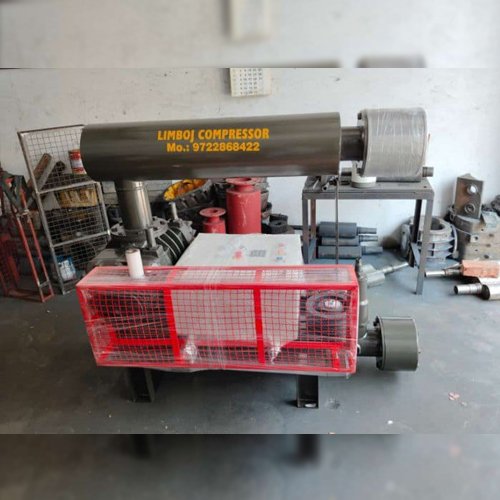
Twin Lobe Air Blower in India
A Twin Lobe Air Blower in India is the backbone of countless industrial air-handling systems — from wastewater aeration tanks to cement silo transfer lines. Built on a positive-displacement rotary lobe design, this equipment delivers steady, oil-free air volumes without the contamination risk of lubricated compressors, making it a preferred choice wherever clean, uninterrupted airflow is critical to the process.
Limboj Compressor, based at Gopinath Industrial Hub, Vatva, Ahmedabad, Gujarat, is a Twin Lobe Air Blower Manufacturer in India engineering rotary lobe blowers, roots blowers, and complete air-handling systems for cement, pharmaceutical, chemical, paper, power, and sewage/effluent treatment (STP & ETP) industries. As a working Twin Lobe Air Blower Supplier in India, we size, build, test, and commission every unit against the actual airflow and pressure conditions of the plant it's going into — not a generic catalogue number.
What Is a Twin Lobe Air Blower?
A twin lobe air blower — also called a rotary lobe blower, roots-type blower, or positive displacement (PD) blower — is a rotating machine that moves a fixed volume of air or gas with every rotor revolution. Two figure-eight-shaped lobes rotate in opposite directions inside a precision-machined casing, trapping air at the inlet and carrying it around the casing wall to the outlet. Compression happens only at the discharge point, against the resistance of the connected pipeline (also called system back-pressure), not inside the casing itself.
This is fundamentally different from a centrifugal fan, which relies on impeller speed to generate pressure, or a screw compressor, which compresses gas internally through a shrinking chamber. The twin lobe design's core advantages are:
- Oil-free, contamination-free air delivery — no lubricant touches the airstream
- Constant volumetric flow regardless of moderate pressure swings downstream
- Simple mechanical construction with fewer wear parts than screw or centrifugal designs
- High tolerance for continuous 24×7 duty, common in aeration and conveying applications
- Bi-directional operation — the same unit can be used for pressure (blowing) or vacuum (suction) duty depending on piping configuration
How a Twin Lobe Air Blower Works
Understanding the working principle helps in selecting and maintaining the right unit:
- Intake stage — Air enters through the inlet port and fills the pocket formed between one rotor lobe and the casing wall.
- Transfer stage — As the rotors turn (driven by external timing gears, not by contact between the lobes themselves), the trapped air pocket is carried around the casing from the inlet side to the outlet side.
- Discharge stage — When the rotor pocket aligns with the outlet port, the trapped air is released into the discharge pipeline. Because the pipeline offers resistance, the air is compressed at this point rather than gradually inside the casing.
- Timing gear synchronization — A set of precision timing gears mounted outside the air chamber keeps the two rotors perfectly synchronized so they never touch each other or the casing wall, eliminating the need for internal lubrication.
- Bearing and seal support — Bearings on either end of the rotor shafts carry the radial and axial loads, while shaft seals (labyrinth or lip-type) prevent oil from the gear chamber migrating into the airstream and prevent air from leaking outward.
Types & Configurations
Not every twin lobe air blower is built the same way. Common configuration variables include:
- Number of lobes: Two-lobe (twin lobe) is the most common; three-lobe (tri-lobe) designs reduce pulsation and noise at a higher manufacturing cost
- Drive arrangement: Belt-driven (allows flexible speed adjustment) vs direct-coupled (more compact, less maintenance on the drive side)
- Mounting: Base-frame mounted, skid-mounted with acoustic enclosure, or panel-mounted for compact installations
- Duty type: Pressure duty (blowing air into a system) or vacuum duty (drawing air/gas out of a system)
- Cooling: Air-cooled (standard for most industrial duty) — casing fins and ambient airflow dissipate heat generated by compression
- Rotor coating: Standard cast iron rotors, or PTFE/ceramic-coated rotors for corrosive or high-cycle applications
Twin Lobe Blower vs Other Air-Moving Technologies
|
Feature |
Twin Lobe (Roots) Blower |
Centrifugal Blower/Fan |
Screw Compressor |
Tri-Lobe Blower |
|
Operating Principle |
Positive displacement |
Dynamic (impeller speed) |
Positive displacement (internal compression) |
Positive displacement |
|
Air Purity |
Oil-free |
Oil-free |
Oil-free (oil-free screw) or oil-injected |
Oil-free |
|
Flow Stability |
Constant, independent of moderate pressure change |
Varies with system pressure |
Constant |
Constant, smoother than twin lobe |
|
Noise Level |
Moderate to high (needs silencer) |
Low to moderate |
Low to moderate |
Lower than twin lobe |
|
Pulsation |
Noticeable |
Minimal |
Minimal |
Reduced vs twin lobe |
|
Typical Use Case |
Aeration, conveying, general process air |
High-volume, low-pressure ventilation |
High-pressure continuous industrial air |
Aeration where lower noise is critical |
|
Maintenance Complexity |
Low-moderate |
Low |
Moderate-high |
Low-moderate |
|
Capital Cost |
Moderate |
Lower |
Higher |
Moderate-high |
Key takeaway: Twin lobe blowers sit in the sweet spot between simple centrifugal fans and more complex screw compressors — offering constant flow and oil-free operation at a lower cost and simpler maintenance profile than a screw compressor, which is why they dominate aeration and pneumatic conveying applications across Indian industry.
Materials, Construction & Components
A twin lobe air blower is only as reliable as its weakest component. Key parts and typical materials:
- Casing/Housing: Cast iron (standard, for rigidity and vibration damping) or fabricated mild steel (for larger custom sizes)
- Rotors (Lobes): Cast iron or ductile iron, precision-machined and dynamically balanced; optionally coated (PTFE, epoxy) for corrosive-gas or anti-wear applications
- Shafts: Alloy steel, hardened and ground for dimensional accuracy
- Timing Gears: Hardened alloy steel gears, lapped in matched pairs for precise synchronization
- Bearings: Heavy-duty roller/ball bearings rated for continuous industrial duty
- Shaft Seals: Labyrinth seals, lip seals, or mechanical seals depending on the application's pressure/vacuum and contamination sensitivity
- Silencers: Inlet and outlet silencers to reduce pulsation noise, often supplied as standard accessories
- Relief Valve: A pressure safety relief valve to protect the blower and downstream piping from overpressure
- Coupling/Belt Drive: Flexible coupling for direct-drive units, or V-belt and pulley assembly for belt-driven units
- Base Frame/Skid: Fabricated steel base for mounting the blower, motor, and accessories as a single package
Each of these components is a potential wear point, which is why component-level quality — not just the final assembled unit — determines the real-world service life of the blower.
Manufacturing Process at Limboj Compressor
Our production workflow for every Twin Lobe Air Blower generally follows these stages:
- Casting/Fabrication — Sourcing or casting cast iron housings and rotors to the required dimensional tolerances
- CNC Machining — Precision machining of rotor profiles, casing bores, and shaft seats to maintain the tight clearances that positive-displacement blowers depend on for efficiency
- Rotor Balancing — Dynamic balancing of rotor assemblies to reduce vibration and extend bearing life
- Gear Lapping & Timing Setup — Matching and setting timing gears so rotors maintain correct clearance through their full rotation
- Sub-Assembly — Fitting bearings, seals, and gear housings before final assembly
- Final Assembly — Mounting the complete rotor/casing assembly onto the base frame with motor, coupling/belt drive, silencers, and relief valve
- Pre-Dispatch Testing — Running the assembled blower to verify airflow, pressure, temperature rise, vibration, and noise levels before it leaves the factory
Testing & Quality Control
Before any blower is dispatched, we check it against the following categories (exact test parameters and reports can be shared on request for your specific order):
- Performance testing — Verifying actual CFM and pressure output against the ordered specification
- Temperature rise testing — Monitoring discharge air and casing temperature over a running cycle to check for excessive internal friction
- Vibration testing — Checking bearing housing vibration levels against acceptable industrial limits
- Noise level check — Measuring sound output, especially important for units heading to STP/ETP sites near residential areas
- Leak/pressure-holding test — Confirming seals and gaskets hold pressure without abnormal loss
- Visual & dimensional inspection — Checking paint finish, fastener torque, nameplate accuracy, and overall build quality against the purchase order
Technical Specifications
|
Parameter |
Typical Industrial Range |
Notes |
|
Product Type |
Twin Lobe Air Blower / Rotary Lobe Blower |
— |
|
Operating Principle |
Positive Displacement |
— |
|
Air Delivery |
Oil-Free |
No lubricant contact with airstream |
|
Housing Material |
Cast Iron / Fabricated Steel |
Selected per size and application |
|
Rotor Material |
Cast Iron / Ductile Iron (coated on request) |
PTFE/epoxy coating available for corrosive duty |
|
Pressure Range |
Low to medium pressure duty (project-specific) |
Finalized against your system back-pressure |
|
Vacuum Range |
Suitable for vacuum-duty applications |
Finalized against your suction requirement |
|
Flow Rate (CFM/Nm³/hr) |
Engineered per site requirement |
Based on process airflow demand |
|
Drive Type |
Belt-Driven or Direct-Coupled |
Depends on speed-flexibility needs |
|
Motor |
Standard industrial squirrel-cage motor (as specified) |
Sized against total power absorbed at max pressure |
|
Cooling |
Air Cooled |
Casing fins + ambient airflow |
|
Duty Cycle |
Continuous / 24×7 Industrial Operation |
Suitable for round-the-clock aeration/conveying |
|
Noise Level |
Reduced with inlet/outlet silencers |
Acoustic enclosure available for noise-sensitive sites |
|
Mounting |
Base-frame or skid-mounted |
Skid packages available with motor, silencers, relief valve pre-fitted |
How to Select the Right Twin Lobe Air Blower (Buying Guide)
Choosing the correct blower isn't about picking the biggest or cheapest option — it's about matching the machine to your actual process conditions. Work through these steps before finalizing your order:
Step 1: Determine required airflow (CFM / Nm³/hr). For aeration applications, this is usually derived from the oxygen demand of the biological process. For pneumatic conveying, it's based on the material transfer rate and pipeline diameter.
Step 2: Calculate required pressure or vacuum. Add up static lift, pipeline friction losses, diffuser losses (for aeration), and any safety margin. Undersizing pressure capacity is a common cause of underperforming aeration systems.
Step 3: Define duty cycle. Continuous 24×7 operation calls for a more conservative sizing margin than intermittent duty, since continuous units see far more running hours per year and less thermal recovery time.
Step 4: Account for altitude and ambient temperature. Air density drops at higher altitudes and higher temperatures, which affects both flow delivery and motor loading — this should be factored into the final sizing, especially for sites outside standard ambient conditions.
Step 5: Decide on drive type. Belt-driven units allow speed changes later (useful if process demand may grow); direct-coupled units are more compact and need less drive-side maintenance.
Step 6: Specify accessories. Inlet filter/silencer, outlet silencer, pressure relief valve, non-return valve, pressure gauge, and acoustic enclosure are commonly specified together — decide upfront rather than retrofitting later.
Step 7: Confirm after-sales support. Check spare parts lead time, service coverage in your region, and whether the manufacturer offers commissioning support — this matters more over a 10+ year equipment life than the initial purchase price alone.
Our engineering team is available to walk through this sizing process with you directly — share your process data sheet and we'll return a matched recommendation rather than a generic quote.
Applications Across Industries
A Twin Lobe Air Blower in India is used wherever a process needs steady, oil-free air or gas movement:
Wastewater & Effluent Treatment (STP/ETP)
Aeration tanks in sewage treatment plants (STP) and effluent treatment plants (ETP) rely on twin lobe blowers to supply oxygen for biological (activated sludge) treatment. Consistent airflow directly affects treatment efficiency, making blower reliability a critical uptime factor for municipal and industrial treatment facilities.
Cement & Building Materials
Pneumatic conveying of cement, fly ash, and other bulk powders between silos, bulkers, and packing lines depends on twin lobe blowers for consistent material transfer pressure.
Chemical Processing
Process air for agitation, oxidation, and material transfer in chemical plants, where oil-free air is essential to avoid product contamination.
Aquaculture & Fish Farming
Pond aeration blowers maintain dissolved oxygen levels for fish and shrimp farming — a fast-growing application segment in coastal and inland aquaculture operations across India.
Power Generation
Ash handling, combustion air support, and flue-gas-related air movement in thermal power plants.
Pharmaceuticals & Food Processing
Clean, oil-free process air where product contamination risk must be minimized.
Paper & Pulp
Pneumatic transport of pulp material and drying-line air support.
Steel & Metallurgical Plants
Furnace combustion air support and material-handling conveying air.
Biogas Plants
Gas transfer and pressure boosting for biogas collection and utilization systems.
Textile Industry
Pneumatic conveying of fibers and process air for certain finishing operations.
This breadth of application is why the equipment is sometimes referred to generically as an industrial process air blower, even though every installation should be engineered individually against its own airflow and pressure requirements.
Maintenance & Troubleshooting Guide
Twin lobe blowers are mechanically simple, but a basic maintenance routine significantly extends service life:
Routine Maintenance Schedule
- Reduced airflow output: Worn rotor clearances, clogged inlet filter, or belt slippage
- Excessive noise: Worn timing gears, bearing wear, or a damaged/missing silencer
- Overheating: Insufficient ventilation, excessive back-pressure, or low oil level in the gear chamber
- Vibration increase: Rotor imbalance, bearing wear, or misalignment between motor and blower
- Oil leakage from seals: Worn shaft seals, typically requiring seal replacement during scheduled maintenance
- Belt wear/slipping: Incorrect tension, misaligned pulleys, or pulley wear
Energy Efficiency & Operating Cost Considerations
- Correct sizing: An oversized blower wastes energy throttling excess flow; an undersized one struggles to meet process demand and may run less efficiently under strain
- Variable Frequency Drives (VFDs): Where process demand varies (e.g., aeration tanks with fluctuating load), a VFD on a belt-driven or motor-controlled unit can reduce energy use by matching output to actual demand instead of running at fixed speed
- Regular maintenance: Worn rotor clearances or dirty filters increase the power needed to deliver the same airflow, quietly raising your electricity bill over time
- Pipeline design: Excessive pipe bends, undersized piping, or long runs increase back-pressure, which increases power draw for the same delivered flow
- Motor efficiency class: Specifying an IE2/IE3-class motor (confirm current availability with our sales team) can reduce running cost compared to a standard-efficiency motor over the equipment's life
Why Choose Limboj Compressor as Your Twin Lobe Air Blower Manufacturer & Supplier in India
Limboj Compressor was built around a simple idea: give Indian industries complete industrial air solutions, not just standalone machines. Beyond twin lobe air blowers, we manufacture roots blowers, powder-handling systems, bulker unloading systems, dual feeding machines, and cement unloading systems — which means we understand how a blower fits into the larger material-handling or aeration system it serves, not just the blower in isolation.
What this means for you as a buyer:
- Engineering-first approach — every blower is sized to your actual CFM, pressure, and duty-cycle needs based on your process data, not sold off a generic spec sheet
- In-house manufacturing at our Vatva, Ahmedabad facility, giving us direct control over casting, machining, assembly, and testing quality
- Pre-dispatch testing for airflow, pressure, temperature rise, vibration, and noise before the unit ever leaves our factory
- On-site installation and commissioning support, so the blower is tuned to your pipeline and process from day one
- Dedicated after-sales service, with spare parts and technical support rather than a one-time transactional sale
- Pan-India reach, supplying plants across Gujarat, Maharashtra, Madhya Pradesh, Rajasthan, Tamil Nadu, Karnataka, and other industrial states
- Direct engineering access — you speak with our technical team by phone or email, not a generic call center
To understand more about our manufacturing background and the industries we serve, see our About Us page, or browse our full product range including Roots Blowers and Powder Handling systems.
Frequently Asked Questions
- What is a Twin Lobe Air Blower used for?
It supplies continuous, oil-free air for wastewater aeration, pneumatic conveying, cement handling, chemical processing, aquaculture aeration, and general industrial process air.
- How is a Twin Lobe Air Blower different from a centrifugal fan?
A twin lobe blower is a positive-displacement machine delivering near-constant flow regardless of moderate back-pressure changes, while a centrifugal fan's output varies more with system pressure. This makes twin lobe blowers better suited to processes needing stable, predictable airflow against varying resistance.
- How is a Twin Lobe Blower different from a Tri-Lobe Blower?
A tri-lobe blower uses three rotor lobes instead of two, which reduces pulsation and noise but typically costs more to manufacture. Twin lobe blowers remain the more common and cost-effective choice for most industrial applications.
- Can Limboj Compressor customize a Twin Lobe Air Blower for my plant?
Yes. Every blower is engineered around your required CFM, pressure range, pipeline resistance, and duty cycle. Share your process data sheet and our team will recommend a matched configuration.
- What maintenance does a Twin Lobe Air Blower need?
Routine checks include filter cleaning, belt tension checks, gear-chamber oil changes, and periodic inspection of bearings, seals, and rotor clearances. See our maintenance guide above for a suggested schedule.
- How long does a Twin Lobe Air Blower typically last?
With correct sizing, installation, and routine maintenance, twin lobe blowers are designed for a long industrial service life; actual lifespan depends heavily on duty cycle, ambient conditions, and maintenance discipline.
- Which industries in India use Twin Lobe Air Blowers most?
Wastewater treatment (STP/ETP), cement, chemical processing, aquaculture, power generation, pharmaceuticals, paper, and pneumatic conveying are the largest users in India.
- Can a Twin Lobe Air Blower be used for vacuum applications?
Yes, the same basic design can be configured for vacuum (suction) duty as well as pressure (blowing) duty, depending on piping arrangement and application requirements.
- What causes reduced airflow in a Twin Lobe Air Blower over time?
Common causes include a clogged inlet filter, worn rotor clearances, or belt slippage on belt-driven units — regular maintenance helps catch these early.
- Do you provide installation and after-sales support?
Yes, our team supports on-site installation, commissioning, and performance tuning, backed by ongoing after-sales service and spare parts support from our Ahmedabad facility.
- What accessories come with a Twin Lobe Air Blower?
Typical accessories include inlet filter/silencer, outlet silencer, pressure relief valve, non-return valve, and pressure gauge; acoustic enclosures are available for noise-sensitive installations.
- How noisy is a Twin Lobe Air Blower, and can noise be reduced?
Twin lobe blowers are moderately noisy compared to centrifugal fans due to pulsation, but inlet/outlet silencers and acoustic enclosures can significantly reduce noise for installations near residential or noise-sensitive areas.
- What size motor does a Twin Lobe Air Blower need?
Motor sizing depends on required flow, pressure, and duty cycle — it should be calculated from the total power absorbed at your maximum operating pressure, not selected off a generic chart. Share your process data for an accurate recommendation.
- Can a Twin Lobe Air Blower run continuously (24×7)?
Yes, twin lobe blowers are commonly specified for continuous industrial duty, such as STP/ETP aeration, provided they are correctly sized and maintained per schedule.
- Where is Limboj Compressor located, and do you ship pan-India?
Our manufacturing unit is at Gopinath Industrial Hub, B 80, Vatva, Ahmedabad, Gujarat 382445, and we supply Twin Lobe Air Blowers to industrial customers across India.
- What is the difference between CFM and Nm³/hr in blower specifications?
CFM (cubic feet per minute) and Nm³/hr (normal cubic meters per hour) are both airflow units; Nm³/hr is measured at standard reference conditions and is more commonly used in Indian industrial specifications, while CFM is common in imported equipment documentation. Always confirm which unit a quotation uses before comparing blowers.
- Do you offer test certificates or witness testing for tender projects?
Yes, if your project requires specific test certificates or witness testing, inform our sales team at the enquiry stage so it can be scheduled into production.
- What is the lead time for a custom Twin Lobe Air Blower order?
Lead time depends on size, customization, and current production schedule — our sales team can confirm an accurate timeline once your specification is finalized.
- Can I upgrade my existing blower system with a Limboj Twin Lobe Air Blower?
In most cases, yes — our team can review your existing piping, foundation, and motor arrangement to recommend a compatible replacement or upgrade unit.
- How do I get a price quote for a Twin Lobe Air Blower?
Share your required airflow, pressure, application, and site conditions with our sales team via phone or email, and we'll return an engineered quote matched to your actual requirement.
Get a Custom Twin Lobe Air Blower Quote
Looking for a reliable Twin Lobe Air Blower Manufacturer and Supplier in India? Limboj Compressor engineers energy-efficient, oil-free blower systems built for real plant conditions — not just catalogue specs.
- Twin Lobe Air Blower in Mumbai
- Twin Lobe Air Blower in Ahmedabad
- Twin Lobe Air Blower in Pune
- Twin Lobe Air Blower in Hyderabad
- Twin Lobe Air Blower in Bangalore
- Twin Lobe Air Blower in Chennai
- Twin Lobe Air Blower in Kolkata
- Twin Lobe Air Blower in Indore
- Twin Lobe Air Blower in Bhopal
- Twin Lobe Air Blower in Nagpur
- Twin Lobe Air Blower in Lucknow
- Twin Lobe Air Blower in Thiruvananthapuram
- Twin Lobe Air Blower in Patna
- Twin Lobe Air Blower in Jaipur
- Twin Lobe Air Blower in Coimbatore
- Twin Lobe Air Blower in Visakhapatnam
- Twin Lobe Air Blower in Surat
- Twin Lobe Air Blower in Delhi
- Twin Lobe Air Blower in Chandigarh
- Twin Lobe Air Blower in Gujarat
- Twin Lobe Air Blower in Maharashtra
- Twin Lobe Air Blower in Madhya Pradesh
- Twin Lobe Air Blower in Uttar Pradesh
- Twin Lobe Air Blower in Bihar
- Twin Lobe Air Blower in Chhattisgarh
- Twin Lobe Air Blower in Jharkhand
- Twin Lobe Air Blower in Goa
- Twin Lobe Air Blower in Telangana
- Twin Lobe Air Blower in Andhra Pradesh
- Twin Lobe Air Blower in Tamil Nadu
- Twin Lobe Air Blower in Kerala
- Twin Lobe Air Blower in Karnataka
- Twin Lobe Air Blower in West Bengal
- Twin Lobe Air Blower in Assam
- Twin Lobe Air Blower in Rajasthan
- Twin Lobe Air Blower in Punjab
- Twin Lobe Air Blower in Jammu And Kashmir
- Twin Lobe Air Blower in Uttarakhand
- Twin Lobe Air Blower in Himachal Pradesh
REACH YOUR DESTINATION
100% SURE AND SAFE